Another great documentary about US Navy SEALs. I DO promise to share videos that AREN’T about the Navy or the SEALs; one might think I’m a bit bias of them. Truth is, I do find these videos intriguing but hold every branch in high regard and know that together they make up the US Armed Forces–a well oiled machine that work together in perfect unison.
Task Force K-Bar SEALs at one of the entrances to the Zhawar Kili cave complex (Photo credit: Wikipedia)
English: US Navy SEALs clearing cave complexes in Zwahar Kili (Photo credit: Wikipedia)
Here’s another set of images of “Spot the Sniper.” These all represent military snipers except for the first (3) I believe. I’ve also added the images that show where they are in the photos, unfortunately I was unable to change the order in my Dropboxso they were in some sort of sensible order. I will continue to try to fix them. (I’ve enabled the folder to be downloaded.) ENJOY! Click the image to get started.
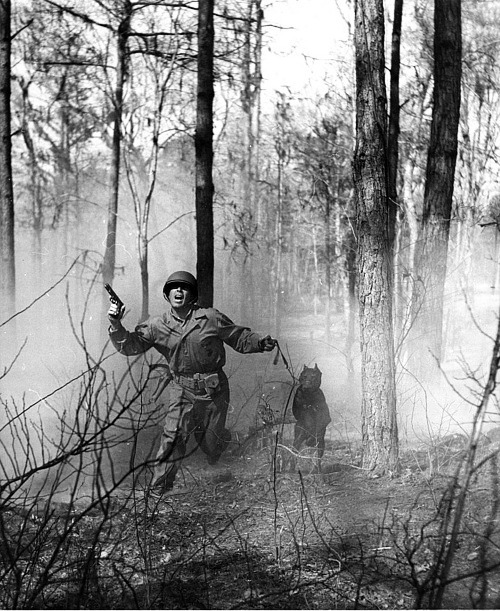
On this day in 1942, the Quartermaster Corps QMC of the United States Army begins training dogs for the newly established War Dog Program, or “K-9 Corps. Read more
Ships and seamen within the U.S. Navy can expect to be at sea for months at a time, with eight month deployments becoming the norm often in dangerous locations or the middle of nowhere.
It is impossible to outfit ships with enough provisions for that long a cruise, so underway replenishment have taken on a new level of importance for the Navy. Read more
Aircraft carriers are the heart of the U.S. Navy. The deck of a carrier is literally a few acres of American territory floating around the world, projecting massive air and seagoing military might. Read more
Here’s the eighth instalment from“The Best of British.”I’ve heard maybe a handful of these terms my entire life. No wonder my friends across the pond chuckle at me; we essentially speak the same the same language but geography has played a big part in the diversity there is between the two counties. Enjoy!
Pear shaped – If something has gone pear shaped it means it has become a disaster. It might be preparing a dinner party or arranging a meeting, any of these things can go completely pear shaped. Read more
FAYETTEVILLE — A new study released by the Consumer Reporting Agency has found that military police officers purchase the vast majority of the world’s Truck Nutz, steroids, and penis enlargement pills. Read more
Franklin D. Roosevelt having a fireside chat in Washington, D.C – NARA (Photo credit: Wikipedia)
On this day in 1933, eight days after his inauguration, President Franklin D. Roosevelt gives his first national radio address or “fireside chat,” broadcast directly from the White House.
Roosevelt began that first address simply: “I want to talk for a few minutes with the people of the United States about banking.” He went on to explain his recent decision to close the nation’s banks in order to stop a surge in mass withdrawals by panicked investors worried about possible bank failures. The banks would be reopening the next day, Roosevelt said, and he thanked the public for their “fortitude and good temper” during the “banking holiday.”
English: Franklin Delano Roosevelt and Herbert Hoover in convertible automobile on way to U.S. Capitol for Roosevelt’s inauguration, March 4, 1933 (Photo credit: Wikipedia)
At the time, the U.S. was at the lowest point of the Great Depression, with between 25 and 33 percent of the work force unemployed. The nation was worried, and Roosevelt’s address was designed to ease fears and to inspire confidence in his leadership. Roosevelt went on to deliver 30 more of these broadcasts between March 1933 and June 1944. They reached an astonishing number of American households, 90 percent of which owned a radio at the time.
Journalist Robert Trout coined the phrase “fireside chat” to describe Roosevelt’s radio addresses, invoking an image of the president sitting by a fire in a living room, speaking earnestly to the American people about his hopes and dreams for the nation. In fact, Roosevelt took great care to make sure each address was accessible and understandable to ordinary Americans, regardless of their level of education. He used simple vocabulary and relied on folksy anecdotes or analogies to explain the often complex issues facing the country.
Franklin D Roosevelt and Josephus Daniels (Photo credit: State Archives of North Carolina)
Over the course of his historic 12-year presidency, Roosevelt used the chats to build popular support for his groundbreaking New Deal policies, in the face of stiff opposition from big business and other groups. After World War II began, he used them to explain his administration’s wartime policies to the American people. The success of Roosevelt’s chats was evident not only in his three re-elections, but also in the millions of letters that flooded the White House. Farmers, business owners, men, women, rich, poor–most of them expressed the feeling that the president had entered their home and spoken directly to them. In an era when presidents had previously communicated with their citizens almost exclusively through spokespeople and journalists, it was an unprecedented step.
Fact Check We strive for accuracy and fairness. But if you see something that doesn’t look right, contact us!
A beach on the Tasman Sea, at the mouth of Heaphy River. (Photo credit: Wikipedia)
The site should be back up now, I’ve shared the link below! (They’ve added new images.)
A digital mapping company that allowed web surfers around the world to hunt the vast ocean waters for the vanished Malaysian jetliner crashed on Tuesday after an overwhelming response. Read more
REGIMENTAL S-1 —Corporal Ronald Fontenot recently checked in from Recon Battalion and everyone he works with in the Admin shop could care less, sources revealed today. Read more
Air Drop Of Supplies In Operation Junction City (Photo credit: Wikipedia)
Operation Junction City was an effort to smash the communist stronghold in Tay Ninh Province and surrounding areas along the Cambodian border northwest of Saigon. The purpose of the operation was to drive the Viet Cong and North Vietnamese troops away from populated areas and into the open, where superior American firepower could be more effectively used. Junction City was the largest operation of the war to date, involving more than 25,000 troops.
Vietnamese paratroopers jump from U.S. Air Force Fairchild C-123B Provider transports in the initial air assault wave during “Operation Phi Hoa II” March 1963. (Photo credit: Wikipedia)
The first day’s operation was supported by 575 aircraft sorties, a record number for a single day in South Vietnam. The operation was marked by one of the largest airmobile assaults in history when 240 troop-carrying helicopters descended on the battlefield. In one of the few airborne operations of the war, 778 “Sky Soldiers” parachuted into the Junction City area of operations 28 miles north of Tay Ninh City.
There were 2,728 enemy casualties by the end of the operation on March 17.
Fact Check We strive for accuracy and fairness. But if you see something that doesn’t look right, contact us!
The following words from Edgar Guest’s poem “The Things that Make a Soldier Great”should help us to truly remember and understand the motivations that are ingrained in every man and woman who has chosen to fight for this great nation.
The things that make a soldier great and send him out to die, To face the flaming cannon’s mouth nor ever question why, Read more
On Tuesday, in Fort Walton Beach, Florida, the surviving Doolittle Raiders gathered publicly for the last time.
They once were among the most universally admired and revered men in the United States. There were 80 of the Raiders in April 1942, when they carried out one of the most courageous and heart-stirring military operations in this nation’s history. The mere mention of their unit’s name, in those years, would bring tears to the eyes of grateful Americans. Read more
This series laid the foundation for media coverage of the later Iraq war. Profiles crews were the first in recent times embedded with U.S. forces in combat. They also were embedded with U.S. Special Forces in Afghanistan and at other fronts of the war on terrorism.
Richard Mackenzie led the production in Afghanistan, working with Special Operations and with infantry units.




 Maiden on the Midway
You must be logged in to post a comment.